
Supporting Johnson City Businesses with Comprehensive Payroll and HR Solutions
Andy Scheu • August 21, 2024

Discover the personalized payroll and HR solutions that make Time & Pay the trusted partner for Johnson City businesses.

Johnson City, Tennessee, is more than just a place where we do business—it's our home. For over 30 years, Time & Pay has been committed to serving the local business community with the same dedication and care that we would extend to our own families. As your trusted partner, we offer a range of payroll and HR services designed to meet the unique needs of businesses in Johnson City. Here's how we can support your business:


1. Payroll Processing: Accurate, Timely, and Hassle-Free

Managing payroll is one of the most critical aspects of running a business. At Time & Pay, we understand the complexities involved and are here to simplify the process for you. Our payroll processing services ensure that your employees are paid accurately and on time, every time. Whether you're a small business or a larger organization, we tailor our services to fit your specific needs, allowing you to focus on growing your business rather than worrying about payroll compliance.


2. Human Resources Support: Navigating the HR Landscape

Human Resources can be a challenging area for many businesses, especially when it comes to staying compliant with ever-changing regulations. Our HR services provide Johnson City businesses with the tools and support needed to manage everything from employee onboarding to benefits administration. We offer expert advice and hands-on assistance, ensuring your business remains compliant while fostering a positive work environment.


3. Automated Timekeeping: Efficiency at Its Best

Time is money, and efficient timekeeping is crucial to maximizing productivity. Our automated timekeeping solutions are designed to streamline the tracking of employee hours, reduce errors, and ensure compliance with labor laws. Whether your employees are working on-site or remotely, our timekeeping systems offer the flexibility and accuracy your business needs.


4. Payroll Tax Compliance: Keeping You in the Clear

Navigating the complexities of payroll tax compliance can be daunting. At Time & Pay, we handle the intricacies of payroll tax filing and reporting, ensuring your business stays compliant with federal, state, and local tax regulations. Our team of experts monitors changes in tax laws so you don’t have to, giving you peace of mind and freeing up your time to focus on what matters most.


5. Customized Solutions: Tailored to Your Business Needs

No two businesses are the same, and we understand that a one-size-fits-all approach doesn't work. That's why we offer customized payroll and HR solutions tailored to the specific needs of your Johnson City business. Whether you need help with payroll processing, HR support, or timekeeping, we work closely with you to develop a solution that fits your business model and goals.


6. Local Expertise: A Partner Who Understands Your Needs

As a locally owned and operated company, we have a deep understanding of the challenges and opportunities facing businesses in Johnson City. Our local expertise allows us to provide personalized service that national providers simply can't match. When you partner with Time & Pay, you’re not just getting a service provider—you’re gaining a partner who is invested in your success.


Why Choose Time & Pay?

Choosing Time & Pay means choosing a local partner who cares about your business as much as you do. Our commitment to Johnson City businesses is reflected in the quality of our services and the relationships we build with our clients. We are here to help your business thrive, providing the tools and support you need to manage your payroll and HR functions with confidence.


If you're ready to take your business to the next level with reliable payroll and HR solutions, contact Time & Pay today. Let's work together to achieve your business goals.


Contact Us
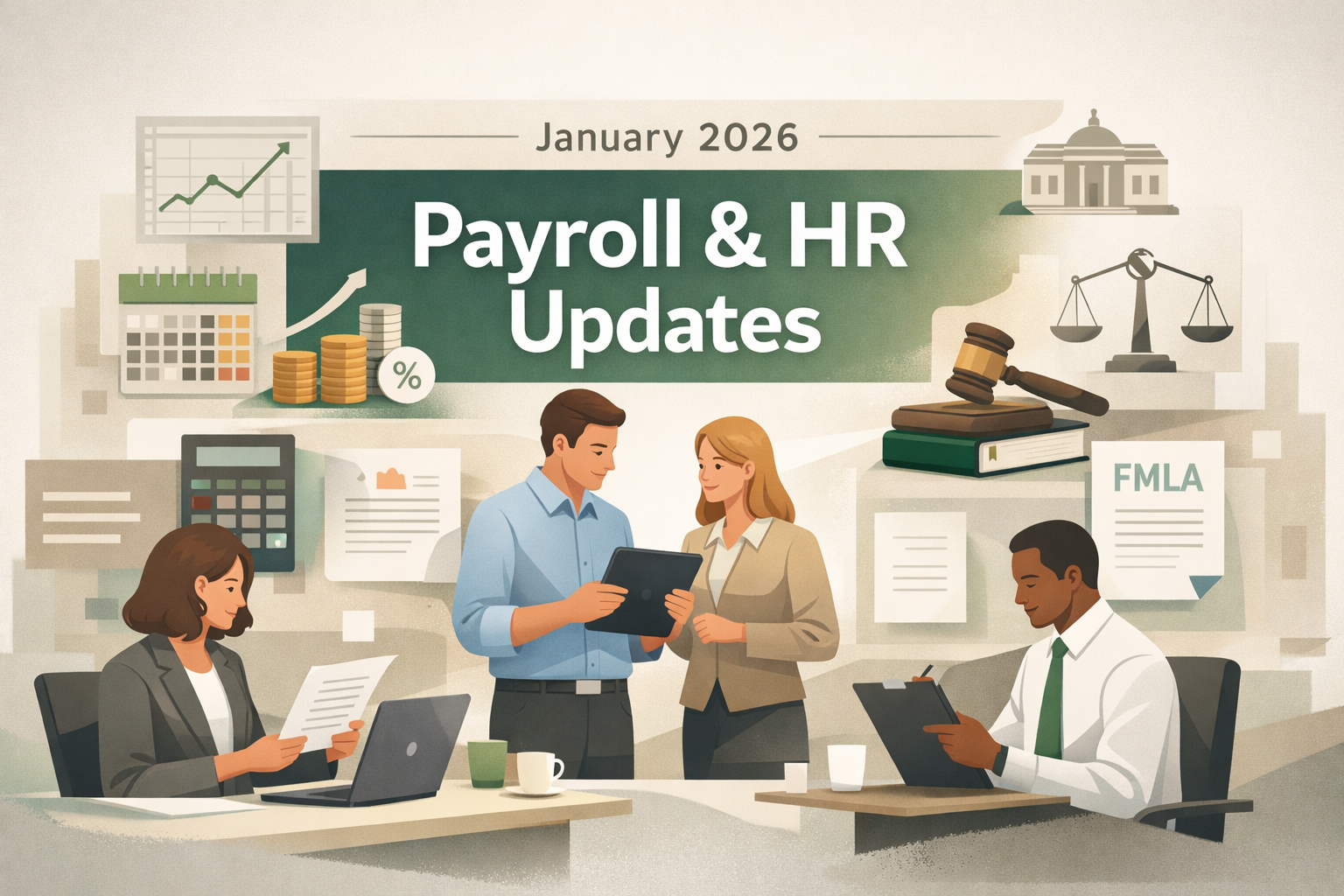
Payroll & HR updates graphic with people reviewing documents. Includes a graph, coins, scales, books, and a gavel.
By Andy Scheu January 28, 2026
Key Employment & Payroll Updates Employers Should Know – January 2026 Staying compliant as an employer means keeping up with changes that affect wages, workplace policies, and employee leave. As we head into 2026, several federal updates are worth your attention—particularly around earnings trends, harassment guidance, and Family and Medical Leave Act (FMLA) administration. Here’s a breakdown of what changed and what it means for employers. Real Average Hourly Earnings Remained Flat in December 2025 According to the U.S. Bureau of Labor Statistics , real average hourly earnings for all U.S. employees were unchanged from November to December 2025. While average hourly earnings increased by 0.3 percent during the month, that increase was offset by a matching 0.3 percent rise in the Consumer Price Index (CPI). In other words, workers saw nominal wage growth, but inflation absorbed those gains. Looking year over year, real average hourly earnings rose 1.1 percent from December 2024 to December 2025. Why this matters for employers: Flat real wage growth can influence employee sentiment, retention, and compensation planning. Even when wages increase on paper, employees may not feel the benefit if inflation keeps pace. Employers evaluating pay strategies in 2026 should factor in cost-of-living pressures alongside competitive wage benchmarking. EEOC Rescinds 2024 Harassment Guidance on Gender Identity The U.S. Equal Employment Opportunity Commission has voted to rescind its 2024 Enforcement Guidance on Harassment in the Workplace. That guidance relied heavily on the Bostock v. Clayton County decision, which held that discrimination based on sexual orientation or gender identity constitutes sex discrimination under Title VII of the Civil Rights Act. The rescinded guidance included examples such as the intentional misuse of pronouns or denying access to bathrooms consistent with an individual’s gender identity. The revocation follows a 2025 federal court ruling in Texas that struck down the guidance. Why this matters for employers: While the specific EEOC guidance has been withdrawn, the underlying Supreme Court precedent has not changed. Employers should avoid assuming this revocation eliminates risk. Title VII protections still apply, and workplace harassment claims may still be evaluated under existing federal law, state law, and company policy. This is a good time to review harassment policies and training materials with legal counsel. DOL Clarifies How Travel Time Applies Under FMLA The U.S. Department of Labor , through its Wage and Hour Division, has issued a new Opinion Letter clarifying how travel time can count toward an employee’s FMLA entitlement. The guidance confirms that time spent traveling to and from medical appointments may be counted as FMLA leave when the travel is related to receiving care for a serious health condition. Importantly, healthcare providers are not required to estimate or certify travel time. The DOL provided several practical examples: • Travel time to and from a dialysis appointment, along with treatment time that overlaps with scheduled work hours, is FMLA-protected. • When an employee transports a parent to medical appointments for a serious health condition, all time spent traveling, waiting, attending the appointment, and returning to work may be counted as FMLA leave—even if the appointment itself is brief. • Leave taken for activities unrelated to medical care, such as accompanying a child on a school field trip, is not FMLA-protected—even if the child has a serious health condition. • Only the portion of leave related to medical care and necessary travel is protected; unrelated personal errands cannot be counted against FMLA entitlement. Why this matters for employers: This clarification reinforces the need for accurate FMLA tracking. Employers should ensure supervisors and HR teams understand that intermittent leave may include more than just appointment time. Clear policies and consistent documentation practices can help prevent miscounts, disputes, and compliance issues. Final Takeaway for Employers These updates highlight a common theme: compliance is rarely static. Wage trends affect workforce expectations, court decisions influence policy enforcement, and regulatory guidance continues to evolve.  Employers should consider reviewing: • Compensation strategies for 2026 • Harassment policies and training materials • FMLA tracking and leave administration procedures Staying proactive reduces risk—and helps build trust with employees in an increasingly complex regulatory environment. Sources & Reference URLs • U.S. Bureau of Labor Statistics – Real Earnings News Release https://www.bls.gov/news.release/realer.htm • U.S. Equal Employment Opportunity Commission – Enforcement Guidance Updates https://www.eeoc.gov • Bostock v. Clayton County (2020) – Supreme Court Decision https://www.supremecourt.gov/opinions/19pdf/17-1618_hfci.pdf • U.S. Department of Labor – Wage and Hour Division Opinion Letters https://www.dol.gov/agencies/whd/opinion-letters • Family and Medical Leave Act (FMLA) Overview https://www.dol.gov/agencies/whd/fmla
Yellow weather closure sign and red
By Andy Scheu January 26, 2026
How to Stay DOL Compliant Despite Inclement Weather Severe weather can disrupt normal business operations and raise immediate payroll questions for employers. Whether it’s snow, ice, flooding, or another emergency, understanding how pay rules apply during weather-related closures is critical for staying compliant with federal wage and hour laws. The answer depends largely on whether an employee is classified as non-exempt or exempt under the Fair Labor Standards Act (FLSA). Non-Exempt Employees: Pay for Time Worked For non-exempt employees (those eligible for overtime), the rule is straightforward. These employees must be paid only for the hours they actually work. If a non-exempt employee does not report to work due to weather conditions, or if the business is closed, the employer is not required to pay for that time. However, employers may choose to allow or require employees to use accrued vacation, PTO, or other paid leave to cover the missed hours. From a compliance standpoint, there is no federal requirement to pay non-exempt employees for time not worked due to weather-related closures. Exempt Employees: Salary Rules Still Apply The rules for exempt employees are more complex. Exempt employees must generally be paid their full salary for any workweek in which they are ready, willing, and able to work. This includes situations where the employer decides to close the business due to weather conditions. If the employer shuts down operations for a day or more, exempt employees must still receive their full weekly salary. However, if the employer remains open and an exempt employee chooses not to report to work due to adverse weather, the Department of Labor considers this a personal absence. In that case, the employer may legally deduct a full day’s pay from the employee’s salary without violating the salary basis rule. Employers may also require exempt employees to use accrued vacation or PTO to cover the full-day absence. What employers cannot do is make partial-day salary deductions. Deductions for less than a full day are not permitted and may jeopardize the employee’s exempt status. Key Compliance Takeaways Here are the practical rules employers should keep in mind: • Non-exempt employees are only paid for hours actually worked. • Exempt employees must be paid if the employer closes. • Full-day salary deductions for exempt employees are allowed only if the business is open and the employee does not report. • Partial-day deductions for exempt employees are not allowed. • Employers may require the use of PTO or vacation where available. Best Practice for Employers From a risk management perspective, the safest approach is to establish a written inclement weather policy that clearly outlines: • When the business will close • How employees will be notified • How pay is handled for both exempt and non-exempt employees • Whether PTO is required or optional Clear policies reduce confusion, prevent disputes, and ensure consistent treatment across your workforce during weather-related disruptions. Why This Matters Improper handling of weather-related pay can expose employers to wage and hour violations, employee complaints, and potential Department of Labor audits. Understanding these rules ahead of time allows payroll and HR teams to respond confidently and stay compliant when emergencies arise. U.S. Department of Labor – Wage and Hour Division (FLSA FAQ) https://www.dol.gov/agencies/whd/fact-sheets/17g-overtime-salary DOL Opinion Letters – Salary Basis Rule https://www.dol.gov/agencies/whd/opinion-letters FLSA Weather Closure Guidance https://www.dol.gov/agencies/whd/fact-sheets/22-flsa-hours-worked Time & Pay's HR Consulting partner, SESCO , recommends that clients review all applicable policy and practices to ensure compliance. For assistance, contact us at 423-764-4127 or by email at sesco@sescomgt.com .
By Andy Scheu January 21, 2026
FAQs: 2025 Overtime Tax Deductions